In the UK each year, 13 billion bags are provided by retail stores out of which only a small percentage are recycled or reused. In landfills, plastic carrier bags can take over 1,000 years to break down.
One of the latest campaigns against carrier bag use is by Marks and Spencer, which recently decided it would charge a £0.05 for each food carrier bag. The retailer believes this could reduce usage of bags by over 280 million per year.
Recommended White Papers
Recommended Buyers Guides
Another alternative is to change the material used from intractable polyethylene – which, although recyclable, is not very sustainable, being derived from hydrocarbon sources – into a compostable or biodegradable material. For example, polyhydroxyalkanoate resins (PHAs) are polymers used for a wide range of compostable packaging applications.
This would mean that bags could be produced for around the same price as the polyethylene ones, thereby remaining free to the customer while breaking down in a landfill or composted by the end user.
Compostable resins
Bioresins.eu, set up by packaging/materials entrepreneur Lutz Richter, looked to corner the market in compostable resins across the UK. Richter has a further two companies set up in the UK – Paperfeel and A&O FilmPac – which produce polyethylene film extrusions for packaging and converting applications.
Bioresins.eu is using the production facilities of A&O FilmPac to produce new biopolymer extrusions from granular starting materials imported from Chinese suppliers. The new cornstarch-based biodegradable and compostable resins are based on PolyLactic acid (PLA) from non-genetically modified sources and PHAs.
The resins are suitable for the same production methods such as injection moulding, extrusion and thermoforming used for more traditional polymers. PHA polymers break down within 90-120 days making them ideal for use in compostable packaging. They have already been used in dog food pouches and bird seed packaging.
Bioresins.eu offers three types of resins, manufactured from renewable materials for the UK and European markets. These include compostable thermoplastic starch (TPS) resin, biodegradable resin and compostable PLA and PHA resin. Compostable TPS resin is milky in texture and can be used for film and moulding applications. Biodegradable resin can either be clear or milky and can be used for film, moulding and foam applications. It can also be used as an additive to polyethylene and polypropylene. Compostable PLA and PHA resins can be used for film, sheet and moulding applications.
All resins manufactured by Bioresins.eu are made from starch altered by bacteria. Once the resin is formed, the bacteria is washed out and a powder is left behind. The powder can be used for making plastic goods or transformed into pellets for further processing.
PHA Polyhydroxyalkanoates
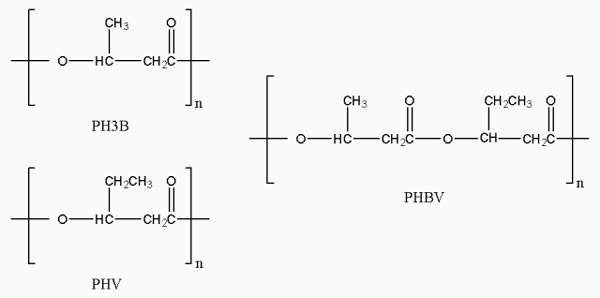
PHAs are polyesters first seen inside bacteria. The plastic can be grown in fermentation vessels using cornstarch as a starting material and transgenic organisms such as Arabidopsis plants, which can express the artificially induced PHA biosynthetic gene. The polymers are processed into granular form and can then be used to produce plastics for converting into packaging.
There are a range of PHAs which could be produced with a wide range of properties to suit the majority of packaging applications.
A good example is polyhydroxybutyrate (PHB), which has physical properties similar to polypropylene, even though these polymers have different chemical structures.
PHB is stiff and brittle but also has a high degree of crystallinity and a high melting point of about 180°C, but of course PHB is rapidly biodegradable, unlike polypropylene.
The PLA resin manufactured by Bioresins.eu is derived from corn-starch. PLA has a texture which is similar to that of petroleum-based plastic. Since it degrades within industrial compost facilities easily, it is the most commonly used bioplastic.
Quality certification
Bioresins.eu received EN 13432 certification for its products, which ensures that it does not affect the environment from the harmful chemicals. EN 13432 certification is one of the strictest of specifications for compostable products.