
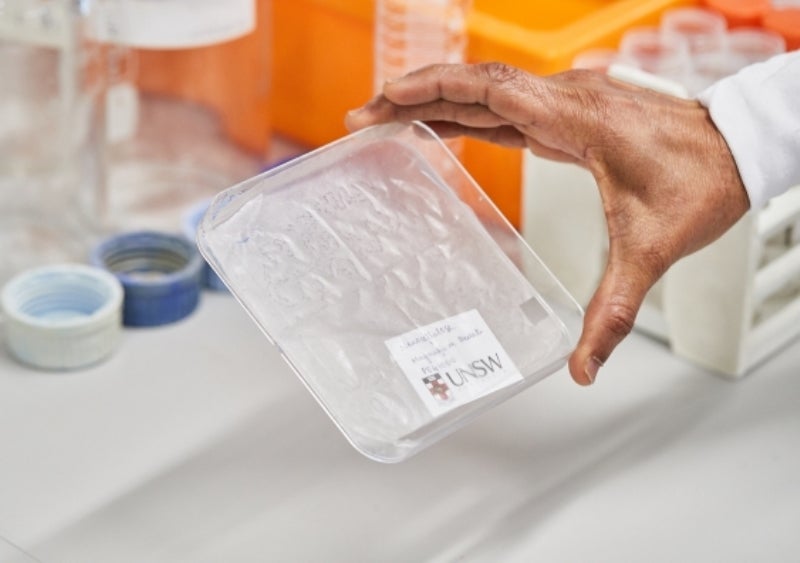
Two researchers at the University of New South Wales (UNSW) Sydney have developed biodegradable and recyclable packaging material from banana plantation waste.
UNSW School of Chemical Engineering associate professor Jayashree Arcot and professor Martina Stenzel were exploring ways that could help to introduce agricultural waste into the circular economy.

Discover B2B Marketing That Performs
Combine business intelligence and editorial excellence to reach engaged professionals across 36 leading media platforms.
The researchers have selected banana-growing industry, which produces large amounts of organic waste. Only 12% of the plant or fruit is used and the rest is discarded after harvest.
Arcot said: “What makes the banana-growing business particularly wasteful compared to other fruit crops is the fact that the plant dies after each harvest.
“We were particularly interested in the pseudostems – basically the layered, fleshy trunk of the plant, which is cut down after each harvest and mostly discarded on the field. Some of it is used for textiles, some as compost, but other than that, it is a huge waste.”
The researchers focused on the pseudostems of the banana plant, which they thought could prove to be a valuable source of cellulose.
According to the researchers, the banana pseudostem could prove to be an alternative to plastic bags and food packaging.
In order to extract cellulose, pseudostem material was sourced from banana plants grown at the Royal Botanic Garden Sydney.
The pseudostem contains 90% water. It can be dried and ground to a very fine powder.
Stenzel said: “We then take this powder and wash it with a very soft chemical treatment. This isolates what we call nano-cellulose, which is a material of high value with a whole range of applications.
“One of those applications that interested us greatly was packaging, particularly single-use food packaging where so much ends up in a landfill.”
Tests have proved that the material posed no contamination risks and disintegrate in the soil.


